
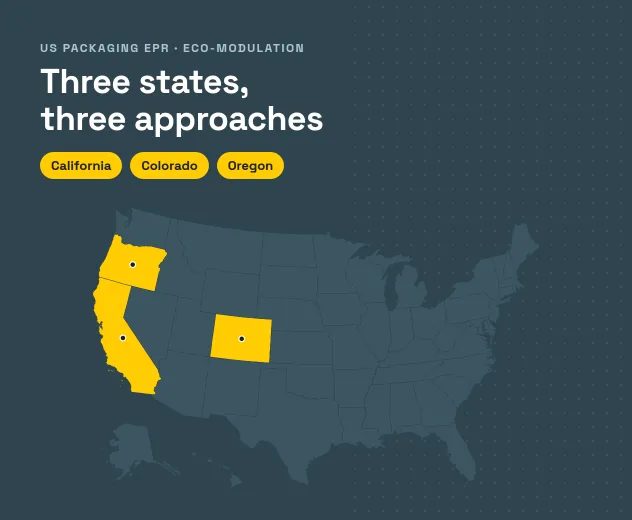
Instead of every producer paying the same rate per pound of a given material, fees are adjusted to reward better packaging design and sustainability.
Three states at a glance
California · SB 54
California: reduction targets with an exponentially increasing bill
California's SB 54 is the most ambitious US EPR law, and the only one to write plastic reduction targets directly into statute: a minimum 25% plastic source reduction from 2023 levels by 2032. These targets are the cornerstone of the state's eco-modulation framework, which consists of four main elements.
2023 baseline report
A report on packaging placed on the California market in 2023, including details on plastic components and weights, to function as the starting point for all future reductions.
Source Reduction Plan
A roadmap of methods and timelines that is not binding but acts as an indication of the steps which will be taken to reduce the amount of plastic used in packaging.
Annual source reduction reports
Submitted on a regular basis to the PRO (CAA) alongside the usual annual supply reports. They measure reduction progress against the 2023 baseline, and are used alongside the supply reports to calculate the amount of reduction implemented.
Source Reduction Incentive Mechanism (SRIM)
CAA's mechanism to translate implemented plastic reduction into lower fees. As the reduction targets from SB 54 are binding on the PRO, rather than individual producers, the SRIM incentivises individual responsibility, with the aim of collectively meeting these targets.
Plastic source reduction from 2023 levels by 2032Binding on the PRO (CAA), not on individual producers.
How the SRIM bill grows
The SRIM is a carrot-and-stick system, but the system works reactively to increase maluses for producers lagging behind the majority. Bonuses are funded directly by maluses, so the size of the bonus pool determines the size of everyone else's bill.
$10 million in bonuses split across 10,000 producers leaves a malus of $1,000 per producer. When only 1,000 producers are left paying, the same pool means $10,000 each; with 100 left, it is $100,000 each.
The more producers that earn a bonus, the more expensive it becomes to keep packaging the same.
Try it: a $10m bonus pool
Still paying a malusEarned a bonus
Illustrative only, using the example above: 10,000 producers, each dot is 100 producers. Actual SRIM values are set by CAA.
Colorado
Colorado: material-level factors and producer-level bonuses
Colorado's approach is more traditional, applying a combination of passive and active eco-modulation factors to incentivise the use of more sustainable packaging. Notably, Colorado's eco-modulation applies to all materials.
Passive factors
Passive factors apply uniform factors across a whole material reporting category after base fees are calculated, drawing on the scoring from the state's Needs Assessment. In the first programme year, the malus raises base fees (excluding reserves) by 5% for the applicable category, and the incentive lowers them by 5%.
There is also a tiered malus for materials outside the Minimum Recycling List (MRL). Materials on the Additional Materials List (AML) must be priced at least 20% above the average for similar MRL materials, and non-collected materials at least 10% above similar AML materials.
How passive factors move the fee
Change against the reference fee, first programme year
- Incentivevs category base fee
- Malusvs category base fee
- Additional Materials Listvs similar MRL materials
- Not collected+10% on similar AML, so at least +32% vs MRL
Active factors
Active factors reward individual producer practices that cannot be assessed at material level: source reduction, recyclability innovation, high PCR content, and reuse and refill.
- Source reduction
- Recyclability innovation
- High PCR content
- Reuse and refill
Producers submit additional data through the portal, which is then verified, and thresholds are informed by an independent technical committee. The data burden is considerable, but so is the opportunity to earn a fee reduction. Colorado also plans to refine the system annually, so these benchmarks will move.
- Submit datathrough the portal
- Data verifiedonce submitted
- Thresholds informedby an independent technical committee
- Refined annuallyso benchmarks will move
Oregon
Oregon: bonuses for life cycle assessment
Oregon has built its system around third-party reviewed Life Cycle Assessments (LCAs), all conducted under OAR 340-090-0900 to 0940 and the EU's Product Environmental Footprint method, covering 16 impact categories.
Bonus A: LCA disclosure
Rewards voluntary LCA disclosure with 10% of base fees (excluding reserves) for the primary packaging in a SKU or batch of related SKUs, capped at $20,000 per SKU or batch. With a maximum of 10 SKUs or batches, that adds up to $200,000 in total.
Up to$200,000
Bonus B: lower impact
Rewards comparative LCAs showing reduced environmental impact of a primary packaging system, tiered by reduction: up to $40,000 for 10 to 40%, $45,000 for 40 to 70%, and $50,000 above 70%. The total across ten SKUs or batches is up to $500,000, credited against future fees.
Up to$500,000
Bonus C: reuse and refill
Uses the same tiers for comparative LCAs showing impact reductions from moving from single-use plastic to reusable or refillable formats.
Per SKU or batchSame tiers as B
Producers can claim Bonus A or B, not both. The first submissions for Bonus B and C were due by 31 May 2026.
Estimate your maximum Oregon bonus
Indicative maximums from the figures in this article; awards depend on Oregon's review of each LCA. Bonus B and C are credited against future fees.
Talk to us about OregonWhere to start
Build one data foundation for all three states
For producers operating across the US, it is important to build a strong packaging data foundation: materials, weights, recycled content and recyclability evidence. That data will serve Colorado's verification process, California's reports, and Oregon's LCA submissions alike. The sooner you build it, the more of these bonuses you can claim.
- Materials
- Weights
- Recycled content
- Recyclability evidence
- ColoradoVerification process
- CaliforniaSource reduction reports
- OregonLCA submissions
Quick check: which of these can you evidence today?
0 of 4 in place. Start with the data you already hold; we can help fill the gaps.
Get help with your dataHow Ecoveritas can help
The rapid rate at which EPR regulations are evolving can be frustrating for businesses that seek to make sense of how they might be affected by a potential law. Ecoveritas has and will continue to keep track of and interpret EPR regulations, along with other environmental laws impacting packaging, textiles, electricals, batteries, and wider sectors. Our exclusive Global EPR Matrix offers a unique insight into EPR laws that should educate you about your business's obligations.
Get in touch with us today to learn more about our services. Please speak to one of our advisors on +44 (0)1865 502176 or email us at info@ecoveritas.com.